
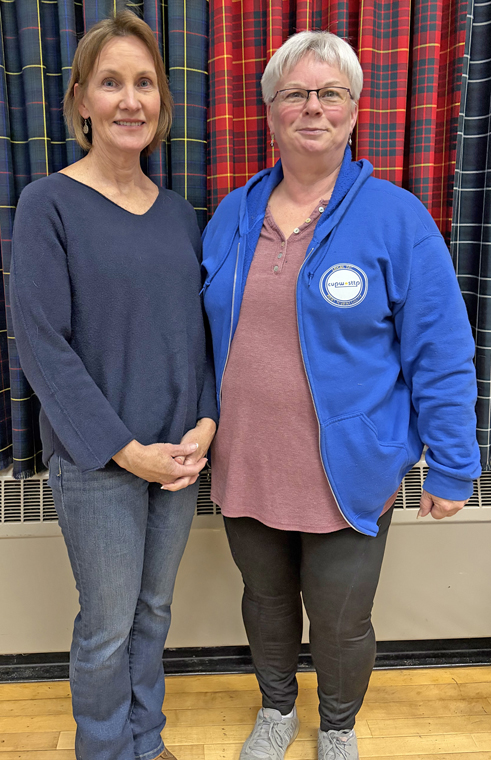
Mail carrier Trena MacEachern and President of the CUPW Port Hawkesbury local 102 Juanita MacInnis were at the Judique Community Hall on Thursday evening to inform the crowd of Canada Post’s plans to eliminate 25,000 jobs, 100 post offices, and door-to-door delivery.
-by Beverley Phillips
The fight to save door-to-door postal service came to Judique last Thursday evening.
As Canada Post announced that door-to-door service for 136,000 addresses in 13 communities across Canada is ending, Juanita MacInnis, President of the Canadian Union of Postal Workers (CUPW) Port Hawkesbury local 102 and a rural and suburban mail carrier (RSMC), was at the Judique Community Centre sharing the postal workers’ perspective of the problems that Canada Post faces. Canada Post’s plan is to end all door-to-door delivery over the next few years, moving residents to collect their mail at community mailboxes (CMB).
This is a move the union is steadfastly opposed to. “We stopped it before in 2015,” said MacInnis, “and we’re going to try to stop it again.”
Under Canada Post’s plans, they will eliminate four million door-to-door addresses, close 100 post offices, and cut 25,000 jobs. This will save the corporation $400 million.
Joel Lightbound, the Government Transformation, Public Works and Procurement minister, said, “What we have to understand is that Canada Post has accumulated over the last couple of years, $5 billion in deficits. This is unsustainable, and repeated bailouts by the federal government are not a long-term solution to Canada Post. It needs to transform.”
MacInnis would agree that Canada Post needs to be transformed, but she and the union see the problem and the solutions differently.
In her opening remarks, MacInnis noted that more than half of the country has home delivery, and only 35 per cent use a community mailbox. The groups that will be impacted the most by changes will be seniors and those with disabilities. “CMB sites have major disadvantages in terms of safety, accessibility, litter, snow and ice buildup, and the environment,” she said.
MacInnis said that labour costs are not the problem at Canada Post. “The cost of labour at Canada Post has been relatively flat for several years. It is the cost of operating that has gone up. CUPW has been in negotiations with Canada Post for nearly two years. We are focused on maintaining good jobs that allow postal workers to raise families in the communities in which they work. We're focused on keeping vital public postal services in these communities. With the roadside mailboxes converted to CMBs and the reduction of kilometres by the elimination of dead-end roads, positions will be lost by rural drivers. This loss of jobs will impact the communities we live in. A large percentage of our income stays in our communities when we purchase gas, groceries, and pay our taxes.”
A key issue the union is talking about is that it has been 10 years since the last mandated public review. “In previous mandated reviews,” MacInnis explained, “extensive public consultations were held across the country, giving all communities and stakeholders the opportunity to share their input about the future of the post office. Last year, the federal government quietly revealed that a mandated review of Canada Post was scheduled to begin in October 2025. However, October came and went, and all mentions of a mandated review were quietly scrubbed from the government website by November. Instead of talking to the public, the government seems uninterested in hearing from those who rely on the postal service every day. This is unacceptable. The government needs to listen to Canadians before it implements devastating cuts that will hurt many communities.”
CUPW has raised solutions that expand, rather than cut, services offered to Canadians. “We understand that mail volumes are declining, which is why we have urged Canada Post to expand delivery services and expand into other revenue-generating services. We have seen support for this time and time again from individuals, municipalities, and organizations. But these voices were ignored by the report being used to justify these cuts.”
“Canada Post claims service expansion proposals cost too much,” she continued, “yet converting four million home delivery addresses to community mailboxes will cost nearly $1.6 billion. When Canada Post converted to CMBs in 2015, it spent $240 million to convert 830,000 civic addresses. Why not invest that money into service improvements that Canadians actually want and use?”
The union has suggested that Canada Post invest install solar panels over existing parking lots as they have purchased electric vehicles, and sell the extra energy. They have also been advocating for installing public charging stations at every post office to enhance the nation’s infrastructure as it increasingly transitions to the green economy.
They also suggested a return to postal banking, which Canada Post had until 1968. “International experience shows that postal banking is a win-win scenario,” said MacInnis. “Postal operators can bring in additional revenue streams while filling gaps in the financial services market. In Italy, almost 70 per cent of the Italian post office’s record-breaking annual revenues in 2024 came from financial, insurance, and payment services.”
She also raised concerns about CEO Doug Ettinger. “In 2019, Doug Ettinger was appointed CEO of Canada Post. He also sits on the board of Purolator, which is 91 per cent owned by Canada Post. This creates a massive conflict of interest. How can a CEO of Canada Post make independent business decisions about a corporation when he receives a second salary and a performance bonus from another parcel company?”
MacInnis noted the increase in spending under Ettinger. “In 2021, Canada Post initiated a massive modernization plan, spending huge sums of money on new electric vehicles, new parcel plants, and upgrades to a computer system. Canada Post claims to continue to lose money, despite continuing to spend.”
In 2022, MacInnis said, Ettinger said he was going to invest $5 billion to upgrade the company. In 2024, he said they lost $5 billion. “In the same period of time,” said MacInnis, “Purolator has increased revenue by 28.6 per cent, increased work force by 20 per cent and expanded services by 30 per cent.”
“Canada Post was designed as a public service. A not-for-profit service. Rural delivery isn’t meant to be massively profitable. Only a public postal service would use profits from other parts of the business to support 6.3 million Canadians living in rural and remote communities. That’s why Canada Post is a public service first and foremost, and that’s why Canada Post needs to invest in revenue-generating services to support less profitable operations such as the rural mail delivery.”
MacInnis mentioned the salaries of management, as they were asked about in a previous meeting. The salaries from 2024: CEO makes $450,000 per year; 15 vice presidents make $300,000 each; 71 general managers make $270,000 each per year; 13 board of directors make $125,000 each; 316 directors also make $125,000 a year; 472 managers make $91,306 each; 732 superintendents make $85,000 per year; and 2682 supervisors make $69,490 a year. These positions also came with 30 per cent bonuses in 2024 and 2025.
The crowd in the room was not happy to hear the changes that are coming, noting how difficult it will be for seniors and people with disabilities to get their mail. They also noted the high cost of using couriers for parcel delivery to the door.
A number of people noted the double-dipping of CEO Ettinger, who works for both Canada Post and Puralotor, and wondered how that was allowed. MacInnis said she has not heard a good answer for that question. She went on to detail how Canada Post was doing well until he took over the position in 2018, and that he overspent in many areas. “It sounds like managed decline,” said one meeting attendee.
MacInnis recommended that people contact their member of parliament, Jaime Battiste. She had postcards on hand for people to sign to send to both him and Minister Lightbound, demanding that there be a full public review as mandated. “Canada Post is a Crown corporation with a public service obligation,” it reads, “and Canadians have not had their say.”
In terms of the new contract that will be voted on soon, MacInnis said she is voting “no.” “I’m not looking for a raise,” she said. “I’m looking to keep 25,000 jobs and 100 post offices open.”
Trena MacEachern, a local mail carrier, agreed with that sentiment and hopes this course can be reversed. “We’re hoping this will start a movement,” she said.
You can send Jaime Battiste and Minister Joel Lightbound letters postage-free to Parliament Hill at House of Commons, Ottawa, ON K1A 0A6.
You can reach Battiste by email at [email protected] and Lightbound at [email protected].
And though it is not his jurisdiction, MacInnis also recommended contacting MLA Kyle MacQuarrie as well, sharing your concerns and asking him to speak out on behalf of his constituents.
Upcoming public meetings in the area will be held at the Port Hood fire hall on April 29th, and the Lake Ainslie Fire Hall on May 5th. May 12th they will be in Mulgrave at the St. Francis Hall, May 18th St. Peter’s United Church Hall, and May 20th L’Ardoise Legion. All events begin at 7:00 p.m. Everyone is encouraged to come out and show their support, learn more, and to sign petitions.
-by Beverley Phillips
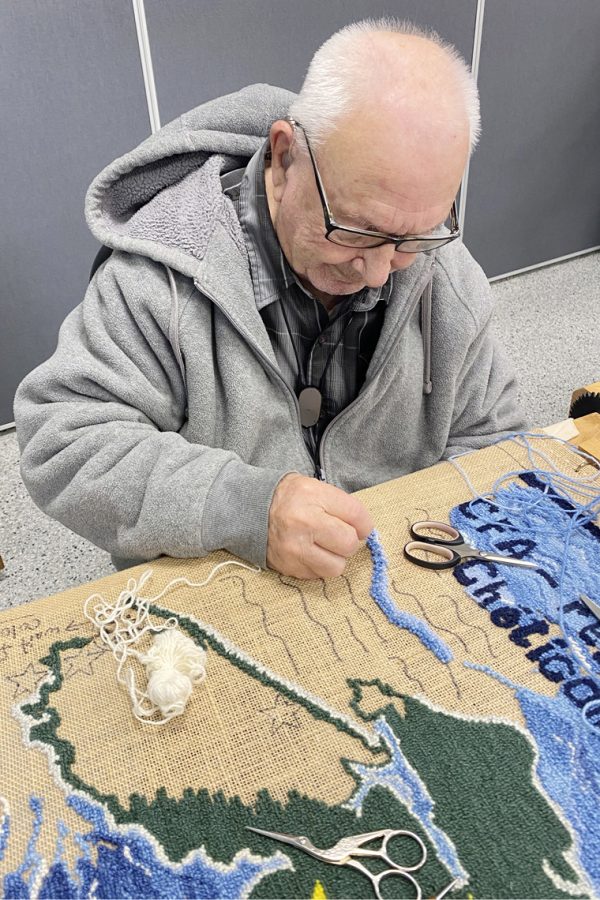
The Chéticamp-style rug hookers of Groupe des hookeuses de Chéticamp want you to join them for a fundraising workshop on Mother’s Day weekend.
“It’s a great Mother’s Day gift,” said club member Betty Ann Cormier, “and it’s perfect for beginners or intermediate rug hookers.”
The workshop includes the rug-hooking kit, healthy snacks, lunch, and the expertise of their instructors in a relaxed, creative space. “All materials are provided. Just bring your smiles and willingness to learn,” said Cormier.
All of the teachers are volunteering their time in an effort to rejuvenate an interest in the art form that once was prolific in the area. “It’s an excellent way to support the revitalization of the craft, helping us continue our work and keep the space that we rent,” said Cormier. “And it’s a great way to get out and socialize and support good mental health.”
The workshop will be held on Saturday, May 9th, from 10:00 a.m. to 4:00 p.m. at Le Canton culturel – Salle des hookeuses. The cost is $150 per participant. To register, contact Betty Ann Cormier at [email protected] or 506-855-4480.
Zoey Gallant, of the Mabou Judo Club, was a silver medalist at the Eastern Canadian Judo championships in Edmundston, N.B., on the weekend.
-by Bill Dunphy
There must be something in that Judique water.
Zoey Gallant, who lives in Judique and is a member of the Mabou Judo Club, brought home a silver medal from the Eastern Canadian Judo championships held in Edmundston, New Brunswick, on the weekend.
Not since Judique’s two-time Olympian, Amy Cotton, began her judo career 40 years ago at the tender age of six has a judoka from that community showed such promise.
Gallant was the sole member of the Mabou Judo Club to attend the tournament. Fighting in the U18 under-70kg division, she defeated her first opponent, Mckenna Proulx-Olson, by ippon in a match that lasted two minutes, one second.
In the gold medal match, blue belt Florence Morin, of St. Hyacinthe, Que., put a choke hold on Gallant and she had to tap-out in the match that lasted 1:59.
There were over 230 judokas at the tournament, including 130 U18 females.
Dwayne Beaton, who is the sensei of the club along with Cotton’s first coach John Angus Campbell, said Gallant was amazing considering she had to fight heavier opponents.
“This was her first time fighting with chokes and arm bars, her first time in the green belt, and up a division, just missing her weight which forced her to compete in a heavier weight division,” he explained.
“Despite all of this, and fighting in one of Canada’s premier judo events, she was able to battle her way to a silver medal performance!”
Gallant said she enjoyed the experience.
“Usually, when I’m training, I fight people my size or bigger. It’s good to fight people over my size because you get stronger for it,” she said.
Gallant, who is 16 and in grade 11 at Dalbrae Academy, said she was in grade nine when she first tried judo.
“I didn’t really know what it was when I first went to the club. But once I tried it I said I’m sticking with it,” she said.
“I like how we don’t do the same thing at every judo practice. Dwayne and John Angus show us different stuff like ground work, standing, and different types of moves.”
An all-round student athlete at Dalbrae, Gallant also takes strength and conditioning sessions with The South’s Steven Graham.
“He’s very straightforward and has helped me a lot in getting stronger,” she said.
Gallant said her long-term goal is to represent Nova Scotia at the Canada Winter Games in Quebec in 2027.
In the meantime, she will attend a meet in Bedford the first week in May and then it’s off to Nationals in Calgary later in the month, hopefully with her friend and training partner Aidan MacIsaac, who broke his foot earlier this year.
Zoey is the daughter of Jenn and Curtis Gallant. Curtis used to drive Amy Cotton to her judo practices but flying to Calgary with Zoey might be a better idea.
Good luck in all your future endeavors Zoey!

April 22, 2026
- Book Fair at Inverness Education Centre Academy
- Raising the flag on Sexual Assault Awareness Month
- Raising awareness, sharing resources on Denim Day in Port Hawkesbury
- County Council briefs
- l'Acabie Transport - Goodwill Gathering well supported by the community
- Local boys represent Novas well at U15 AAA Atlantics
- U18 Wave boys capsize Clare for Super Series 2 v-ball win
- Keenan Gillis steps up as head coach of U18 Major Islanders
- Islanders celebrate 2025-26 season at awards banquet



The Inverness Oran is a locally owned and operated newspaper publication with offices located in the county of Inverness, Nova Scotia, Canada. Printed 52 times per year, The Inverness Oran caters to residents of Cape Breton Island, Nova Scotia as well as national and international readers.
Readers can take advantage of a flexible subscription package available for 3-months, 6-months or 12-months periods, available in a Print Version, a Digital Version, or both. First published in 1976, The Inverness Oran continues to serve and reflect residents and communities of Inverness County.