
-by Beverley Phillips
The art gallery at the Inverness County Centre for the Arts was silent as Julie Forgues drew her artist talk to a close.
The visual artist from Moncton had just read what was essentially a love letter to Svalbard Island, one of the key subjects of her work.
Svalbard Island is an Arctic archipelago found halfway between mainland Norway and the North Pole. The ecosystem is fragile and largely protected. The island plays an important role in the security of the future being home to the global seed vault, conserving plant genetic diversity under the UN organization for food and agriculture.
Forgues has completed two artist residencies on Svalbard. The first was in 2016 during the summer solstice “when the sun never sleeps,” aboard the Antigua, a fishing vessel that was transformed into a three-masted tall ship. After she left, the island remained with her. The northern landscape never left her mind. She realized she had left a piece of herself there, and she knew she had to go back – which she did in 2023. Forgues spoke about the beauty and the magic of the Arctic with its ice and rocky landscapes and polar bears. Of “in betweens,” fluctuating boundaries that are neither a space nor a place, but something liminal in between.
As she read her letter, she began each paragraph with “Dear Svaldbard,” as she told the island about what she saw and experienced. You could hear the compassion and concern she had for the people and places she visited, whether on her residency in China, as she found “in betweens” there, in sites abandoned, left to disrepair, and in villages that were razed to the ground, or in Iceland, where tourists and sheep are transforming the landscape of that northern island.
In 2023, when Forgues returned to Svalbard, she had plans for what she wanted to do, but then she saw how much had changed since she was last there and discovered that climate change must now be part of her work. “The smallest impact of your fragile system will come back to haunt us if we don’t take care of you,” she wrote to Svalbard. “Now is not the time to grieve. Now is the time to change, so we don’t have to grieve.”
Forgues could see the melting glaciers and wondered if the island knew it was warming seven times faster than the global average. She could see the shifts in the plant life, and noted a great paradox. “This is the fact that your region is the most affected by climate change by the actions of the south,” she said. “For this, Svalbard, I am so very sorry.”
And then there is the plastic. For a place with very few people, plastic was on Svalbard’s shores and in her waters. She later learned about microplastics, and how they are eaten by wildlife. She and some colleagues collected much from the coastline, but had to leave before they could collect it all. “I felt as if I was leaving you with open wounds, with lasting pain,” she said. “I didn’t want to go, but I had to leave this little part of you, while allowing some plastic to remain in your membrane. I’m so very sorry.”
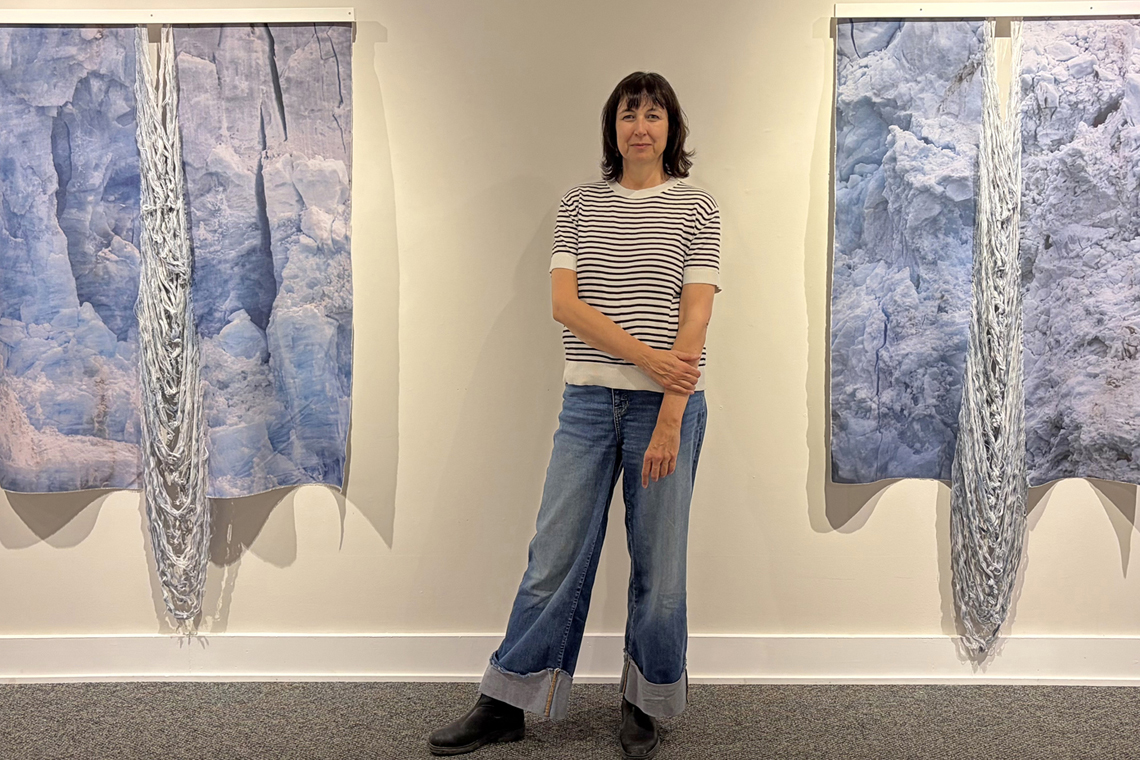
Forgues’s presentation clearly moved those gathered in the art gallery. She shifted gears to talking more technically about some of her work and more specifically about some of the pieces in the room. There are seven large images of glaciers printed on fabric. In the middle of each piece, there is a section that has been unthreaded, each one with more unthreading than the last. The unthreading represents the deterioration of the glaciers by climate change. The seven images represent the seven-fold increased rate of warming that Svalbard is experiencing. Those seven images are repeated on a smaller scale in shadow boxes with those removed threads, which increasingly obscure the image as the glacier.
She mentioned that artists should be called upon to speak about climate change since scientists haven’t been able to get the message across effectively. Asking her to expand on that after the show, Forgues said, “I think we’re in the middle, between a scientist and the people. The arts can be visual or even written, but it’s our different way of seeing things, or writing things, or understanding things, to put forth for the people to help them be able to understand it in a personal way.”
Forgues brought up data centres and their water use during her talk as well. Given the topical nature of the issue, she added, “But not only is it impacting the land, and especially the water, which then trickles down to the land, it’s starting to impact young minds – and old minds, too. I’m a professor at a university, and students can’t write anymore by themselves, or can’t even do an art piece by themselves. Because they can go on AI and do all the prompts of the projects that we say, and then something visual comes up. They come to us and say, ‘I want to do this,’ but I say to them, ‘Can you not just sketch something yourself?’ But also just writing, like writing an artist statement, and writing a description of the work. I keep telling my students, ‘If you can’t write for yourself, you can’t think. You can’t process. You can’t critique. If A.I. does all that for you, your brain’s just going to be a blob. You won’t be able to talk to journalists. You won’t be able to explain your work. You won’t find the words. So it’s melting the brains of the youngsters and taking their water away.”
Creating her own art and bringing science into it is something that Forgues is going to be continuing as she expands on a work exploring the connected geology of the Maritimes and Iceland and the Highlands of Scotland. The far-flung lands were once connected in Pangea millions of years ago, and the beginnings of that work are reflected in the connected series of photos in the art gallery. Forgues hopes to one day bring that back and create a line that doesn’t end, as the connections remain, and the land remembers us.
To see Forgues’s exhibit, land remembers us: from the Arctic to the Caledonians will be at the Inverness County Centre for the Arts,16080 Highway 19, Inverness, until December 13th. Admission is by donation, and the gallery is open Tuesday to Sunday from 12:00 p.m. until 5:00 p.m.