
-by Frank MacDonald
The love she shared so freely continues to connect our family and her friendships, and stands as a reminder that a life lived with such richness of artistry and compassion leaves a lasting imprint on the hearts of so many who continue to miss her every day.
-Stacey McEachern Waugh (niece)
Inverness artist Virginia McCoy (1948-2022) was an admired creator of hundreds of works of art. Her exhibits included Becoming White (University of Cape Breton Gallery), Monumental Artifacts (Baddeck), and also included a retrospective of her work at the Inverness County Centre for the Arts. Her work had also appeared in numerous exhibitions across the island and throughout mainland Nova Scotia.
Virginia’s talent, turned to illustration, enrich three children’s books, TR’s Adventure at Angus the Wheeler’s (story by Frank Macdonald), The Rabbits’ Race (story by Deborah Delaronde) and Christmas LaPouchine (story by Deborah Delaronde). For The Rabbits’ Race Virginia was presented with an award for illustration.
When illness brought her creative life to a close, she was happy with the reception as Cape Breton Island welcomed her work. But Virginia had one longing, one hope, that was unfulfilled.
Virginia McCoy was born in Fort William (now Thunder Bay) of Ojibwa and English parents, Neil and Violet McCoy. Her Ojibwa blood gave her family connections to many, if not most, of the families living in the Fort William First Nation. She had nursed the hope that she could make contact with a Thunder Bay gallery and arrange to an exhibit there. That contact never materialized while Virginia was alive.
But it was neither ignored or forgotten. Two of her cousins, Celina Reitburger and Elysia Petrone, worked towards helping Virginia’s dream come true. It took a couple of years, but eventually the Thunder Bay Art Gallery showed an excited interest in Virginia’s art, and exhibiting it.
It took the gallery and curator Penelope Smart two more years of planning and preparation in acquiring through loan a large number of Virginia’s original paintings. From family members, from friends who patronized the artist, and especially Rolf Bauman of Friends United, who possesses the largest collection of Virginia McCoy paintings.
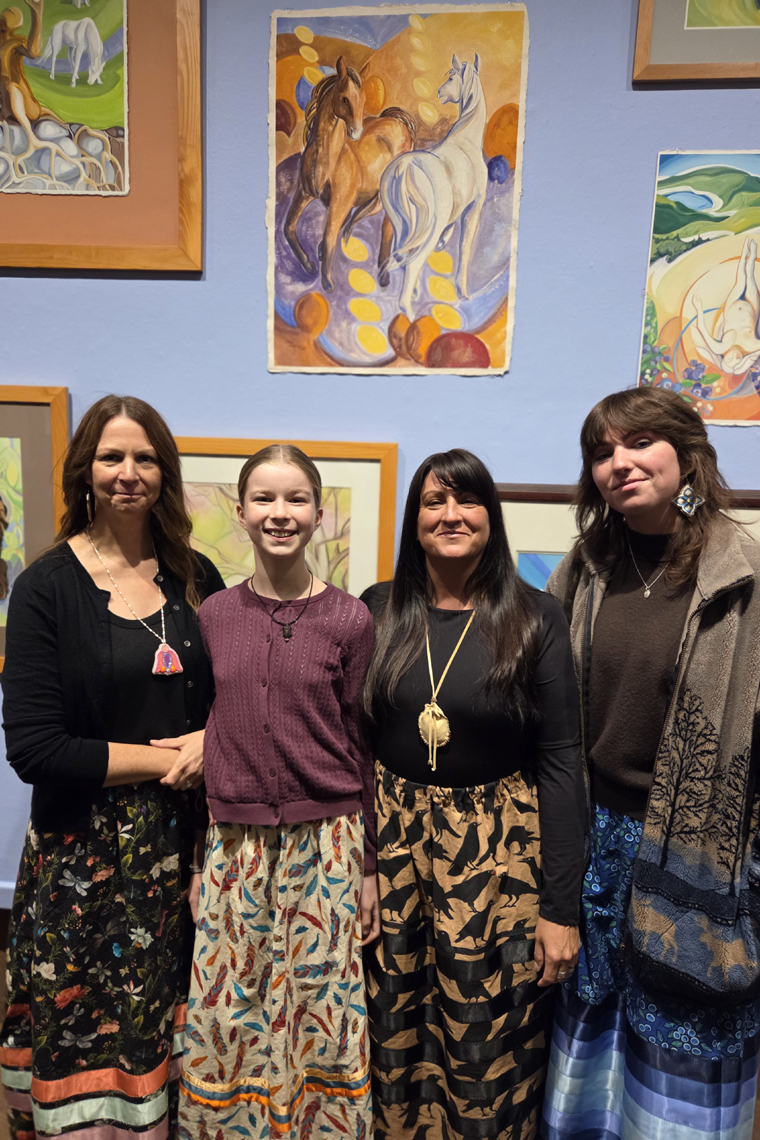
Earlier this month, over the Thanksgiving weekend, the Thunder Bay Art Gallery hosted the opening of Holding Up the Sky: Virginia McCoy, A Retrospective and Homecoming. The title, along with the write-ups accompanying each painting, were also there in the Ojibwa language.
The opening of Holding Up the Sky began with a drumming group. The group explained that with their music and songs they were “calling down the grandfathers, including Virginia.”
Janelle Pelletier, Chief of Fort William First Nation, spoke of the stories that existed in so many of Virginia’s paintings, “stories not told in history books.”
Virginia and her family did not live on the First Nation land because their grandfather in the 1930s had allowed himself and his family to be disenfranchised…surrender their First Nation status. In exchange for this sacrifice he was given land along Lake Nipigon. Consistent with the history of betrayals, the land upon which he planned to raise his family and operate a farm, was a useless, stone-filled and meaningless piece of real estate.
The family eventually found itself in Fort William where Virginia grew up, aware of her Ojibwa heritage but because of Canada’s Indian Act was unable to claim her status.
Following high school, Virginia attended the University of Toronto. Later, she went to work for Manulife Insurance. She had a degree, spoke four languages, worked for a corporation that offered lots of opportunities. None of these accomplishments settled the restlessness that governed her life.
One vacation, she took a trip to Cape Breton to visit a friend, After crossing the Canso Causeway, she stopped her car beside the road and watched the sunset. “I felt like I had just come home,” she said of that moment.
A year later she left Manulife and returned to Cape Breton to stay, with the intention of becoming an artist. Except for a couple of weekend instruction courses, she had no art experience but was irrelevant. She settled near Inverness and began to paint. It was successful in a minor way, but the experience told her she was a long way from her dream, to become an artist.
She quit painting for two years, survived on minimum wage employment but was intent on remaining on the island. Then a friend gave her several tubes of gouache paints. It became the medium that would define all future Virginia McCoy paintings. Their bright, joyful colours allowing her vision of her subjects to unfold fresh and original.
In the 1990s, the federal government introduced changes to the Indian Act that allowed Virginia McCoy to claim her place as a status member of the Fort William First Naion. It also inspired her to gather the family stories she already knew, to research documents and to interview family and First Nation people. It culminated in the 2004 exhibition at the University of Cape Breton Gallery of her Becoming White series.
That collection, although it name may suggest something accomplished, was a tracing down through the generations from the Hudson Bay era through to the 20th Century. Painting to painting, Becoming White traces how her immediate family eventually became disenfranchised. The series documented what was culturally lost to herself and her family because of effectively and lawfully “becoming white.”
A cultural benefit of her genealogical research, noted Chief Janelle Pelletier, was that the information Virginia McCoy had accumulated also touched many other families living on the Fort William First nation land.
Becoming White was an opening of an art exhibit that also held an emotional surprise for its creator. More than a dozen cousins and her Auntie, Dorothy Forrest, made a quiet trip to Cape Breton, arriving on the island and on the campus the evening of the opening to surprise Virginia. They did!
Through the next three decades, Virginia McCoy spent most of her time in her studio in Inverness. Other time was spent with her dogs (or her friends) exploring the forests and mountains surrounding the town. She searched out long abandoned farmland and houses. Those empty, collapsing farm houses, Virginia McCoy believed, still contained the energy of the generations of lives that had lived in them. Those searches resulted in an collection titled Monumental Artifacts.
No subject seemed to dominate Virginia’s output more than her love of horses, and rendering them in various graceful settings. But her entire life’s work spanned an inexhaustible interest in re-creating the world within which she lived, whether as it existed out her kitchen window or took her imagination under the sea in search of breaching whales or the simple beauty of an aster.
“(Preparing this show) was a wonderful opportunity to get to know Virginia and her work, which incorporated the Woodland style. She always wanted to bring her paintings home,” Penelope Smart told the gathering.
“Auntie’s work is also a love letter to our family, to the Fort William First Nation, and to the scared spaces that she knows our ancestors are interwoven with,” Virginia’s niece Stacey McEachen Waugh told those gathered for the opening.
The opening of Holding Up the Sky took place on the Thanksgiving weekend when several relatives of Virginia McCoy were able to attend, coming from as far away as British Columbia and Cape Breton Island on the East Coast. The decision was made to turn the opening of Virginia’s show into a family reunion, a weekend of food, sweat lodges, food, the climbing of a sacred mountain, food, and through it all the spirit of Virginia McCoy was the guest of honour.
Holding Up the Sky will be in the Thunder Bay Art Gallery from October 10, 2026 – January 3, 2027.