
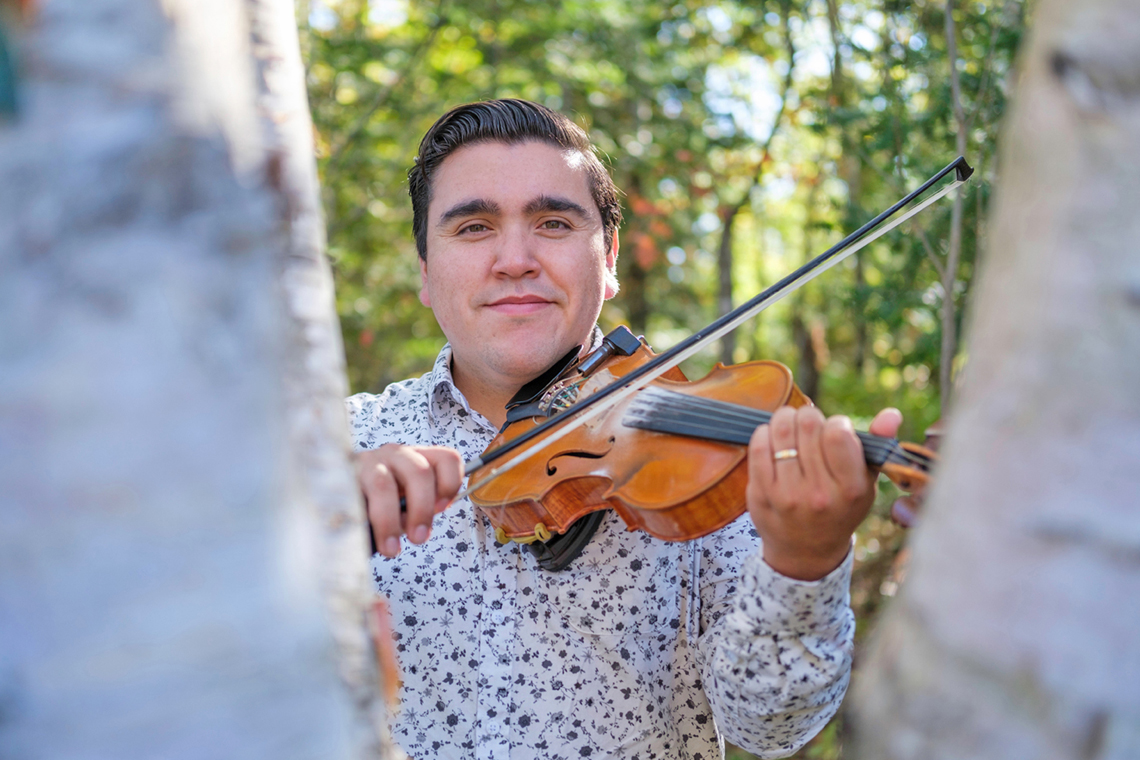
Morgan Toney won the Juno for Best Traditional Roots album on March 28th.
-by Beverley Phillips
Juno winner Morgan Toney is back home in Wagmatcook, but has yet to hold Canada’s top music award in his hands.
Toney won the Juno for Best Traditional Roots album for his 2025 album Heal the Divide. His music is a blend of Mi’kmaw and Celtic sounds that has been dubbed Mi’kmaltic. It’s his second nomination and first win.
He wasn’t on hand to receive the reward in Hamilton on March 28th as he was on tour in BC. But he was watching the proceedings live and released a video of his reaction on his social media account in which he exclaimed, “We did it!” and ran around the room he was practising in with bandmate Ryan Roberts. They immediately called Keith Mullins, the third member of the group, who was unable to be on tour with them.
Speaking to Toney a week and a half after the win, he said he’s still on high. “After a couple of days of just relaxing at home,” he said, “I’m thinking about it a lot, and I’m pretty blown away. It feels great.”
He hasn’t had a party to celebrate yet, but is planning one for when the Juno actually arrives. As of the Oran deadline, the award is in transit.
On how Heal the Divide came to be, he said, “Well, the whole album started a couple of years ago. We were just talking about themes, about what we wanted to do, but the most important thing that we wanted to do was take our music up a notch. The First Flight album and the Resilience album were great, but we wanted to connect with other artists around Cape Breton Island. We reached out to Stony Bear singers and a couple of Keith’s friends that he knew in Sydney. But this whole album is pretty much an experiment when you think about it. We’re trying out new sounds, new instruments, new harmonies, and I think it’s probably going to be the best album that we ever put out. We’re really proud of it.”
That Toney has two Juno nominations and one win under his belt is impressive, given he only took up fiddle playing in university in 2018. He studied music at Cape Breton University, and as part of the program, he had to take some performance classes, and that’s where he learned to sing and play the fiddle. “I had to take a fiddle course in the first year, and I felt like the course was not really for me as a beginner, as someone who didn’t know how to play the fiddle or read music. It was very difficult for me just to get through the first month. The instructor there at the time, Stan Chapman, was very helpful throughout that whole first term. He would spend extra hours with me before class or after classes to make sure that I was on the right page. For him giving me that time, it really meant a lot. And through that first year, I had the chance to go down to a couple of venues around CBRM (Cape Breton Region Municipality), like the Governor’s Pub and the Blue Mist down in Bras d’Or. So I got to hang out with those people as well, exchange tunes and knowledge, and learn from them. That whole first year was overwhelming, but it was probably one of the best years in my life.”
At one point, he considered giving it up as he was struggling with it, but then his mother, the late Jacqueline (Jackie) Anne Toney of We’koqma’q, shared some family history. He said, “I thought to myself, ‘I don’t know if I can do this. Maybe I should just find something else to do.’ I came back home, and it was actually my late mother who told me, ‘Morgan, there’s music in this family – your great-grandfather played the fiddle. Three of your great uncles played the fiddle. None of us (her generation) played the fiddle.’ She said it felt so good for her just to hear the fiddle music played in the house again after so many years. When she told me that, I told myself, ‘Okay, maybe I should stick with this. If it’s making people feel a certain way, I’m gonna stick with it.’ And that’s what I did.”
Jackie was always encouraging and supportive of whatever dream her son had as he was growing up. “I would always tell her, ‘I would love to try doing this someday,’ and she would say, ‘Yeah. You would be great at doing that. Let’s watch some videos on how people are doing it.’ I wanted to be a hotel manager, and we would watch videos of people who were managing hotels. I told her I wanted to be a musician, and we’d watch some of her favourite musicians. She didn’t burst any bubbles. She wanted me to figure it out on my own. When I told her that I wanted to be a musician after she told me about the whole family history, she told me, ‘You know what? This is probably the best dream that you ever had, and I think you should stick with it.’”
Sticking with it and getting connected to Mullins and Roberts has taken him not just across the country, but around the world. Through the sponsorship of the National Art Centre in Ottawa, Toney and the band played at Expo 2025 in Osaka, Japan. He was worried about the cultural and language barrier, but the organizer at the Canadian pavilion spoke fluent Japanese and introduced the band at every show and translated the story of each song. “Even though they didn’t speak any of my languages, you can still see them enjoying the music and enjoying the notes, the chords, whatever Keith’s doing on his cajon, all of our music skills coming together. They were there for it, and they listened to every single note. They’re really attentive, and they were definitely some of my favourite shows I have ever done.”
Morgan’s music has not only translated well to international audiences, but he sees his music as being part of the Canadian truth and reconciliation process here at home. And while he understands those who say the Mi’kmaw and Scottish styles of music should be separate, he sees it otherwise. “For me, truth and reconciliation can mean a lot of things. For me as a musician, from what I have seen over the past few years that we have been doing this, seeing people come out to our shows where they all come from different backgrounds, different cultures, they speak different languages. They only come out to hear music. For me, that is truth and reconciliation. For them to come to our show and hear our story and to hear the history of the Mi’kmaw people, that’s truth and reconciliation as well.”
He agreed with what Eskasoni elder John Sylliboy said at Judique’s 250 celebration last year. Sylliboy was part of a reenactment of the first settler, Michael Mor MacDonald, landing on the shore, and he spoke about how the Mi’kmaw helped MacDonald survive that winter. But he also spoke about how the Mi’kmaw and the Scottish people formed a friendship over the sharing of stories and songs, and that it was time to rekindle that relationship, and the best way is through story and song. “John is absolutely right,” said Toney. “We have to rekindle our friendships, especially with the Acadian people as well. Or people who are not familiar with Mi’kmaw people, or those who have a certain stance about us. We all just want to get along at the end of the day. Let’s all just get along, and let’s make this world a better place together.”
If Sylliboy is right, and that music and story is how these past relationships are best rekindled, then Toney’s music is already doing the work.