
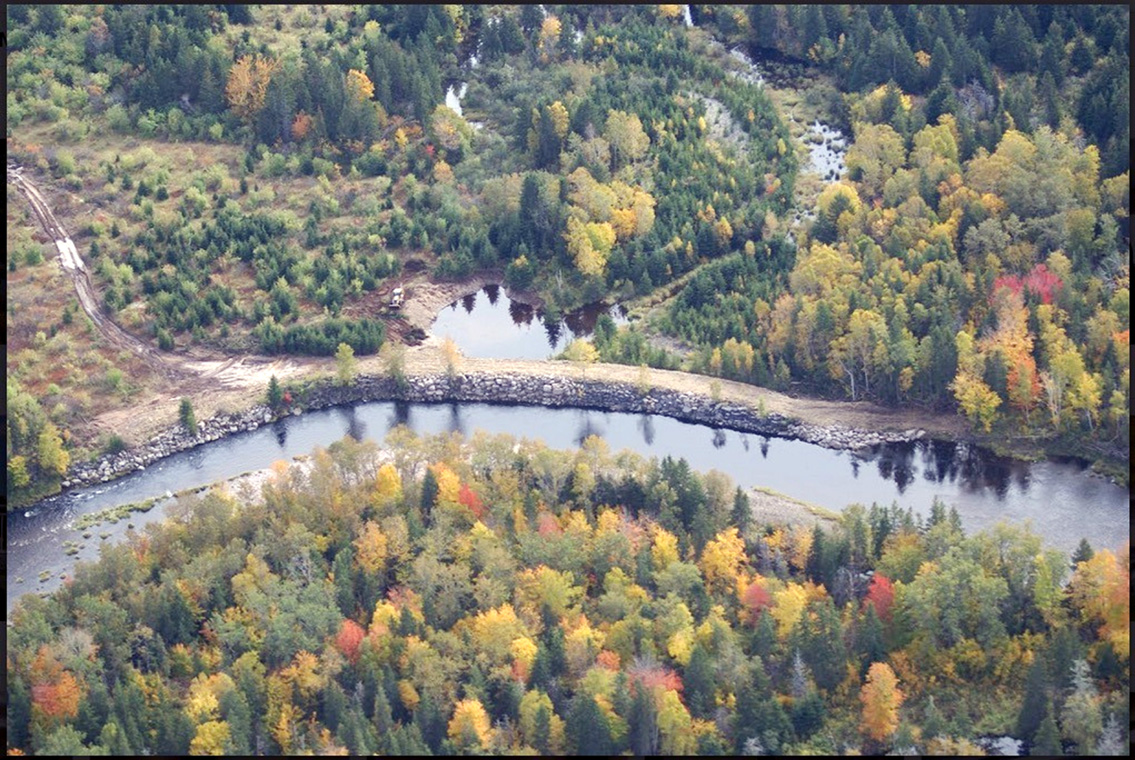
Breakwater pool berm repair completed in October of 2019. (Margaree Salmon Association photo)
-by April MacDonald
On March 13th, the Minister of Fisheries, Oceans and the Canadian Coast Guard, the Honourable Diane Lebouthillier announced Canada’s first ever conservation strategy to restore and rebuild wild Atlantic salmon populations and their habitats.
This strategy will guide the department and their partners in working together to mitigate threats and ensure healthy ecosystems that can support Atlantic salmon.
Since 2021, they have engaged with Canadians, stakeholders, partners, provincial governments and Indigenous organizations on the Strategy.
The department will continue to collaborate with these groups in implementing and reviewing the Strategy to help shape its evolution.
They said that, “restoring Atlantic salmon is a priority.”
“Launching the Wild Atlantic Salmon Conservation Strategy is a positive first step. ASF, our partners, and thousands of people in Eastern Canada have been urging DFO to follow through. We recognize the funding today is an important down payment that will make a difference on the ground in 2025 and sets the stage for a much-needed substantial investment in years to come. ASF stands ready to contribute expertise and resources to help make this Strategy a success,” said Louie Porta, president and CEO, Atlantic Salmon Federation.
The Oran reached out to multiple stakeholders in the Margaree area to hear their thoughts on the recent announcement.
Paul MacNeil, president of the Margaree Salmon Association, said that the Margaree Salmon Association has followed and in some cases participated in the development of this strategy for a few years now.
“Like many conservations groups involved with Atlantic Salmon over the years (for MSA this started in 1982) we’ve pushed hard for help to protect this iconic species. When the federal government abandoned the hatcheries raising Atlantic Salmon a local group in Margaree stepped in and maintained our local hatchery until the province took it over,” explained MacNeil.
“In the last 10 years we’ve struggled to acquire funding to continue our work in the Margaree Watershed. One of our sources of funding has been the Atlantic Salmon Conservation Fund (ASCF), recently renamed Foundation for Conservation of Atlantic Salmon (FCAS). This fund maintained by a board of directors from all four Atlantic Provinces and Quebec was established by a one-time contribution of funds from the Federal Government,” he added.
MacNeil said that the announcement of this federal strategy is welcomed and long overdo.
“When you look at the support they have on the West Coast in relation to preserving Pacific Salmon, we hope that it will be as comprehensive. Volunteer and non-profit groups are the backbone of conservation efforts on the East Coast. Nova Scotia Salmon Association and the Nova Scotia Department of Inland Fisheries have supported conservation efforts in the Margaree River Watershed for many years. Atlantic Salmon Federation (ASF) recently introduced a Wild Salmon Watershed (WSW) program and with support from AERF they’ve provide funding to a number of river association on the East Coast, we hope to see this program expanded,” he said.
“We are very pleased to see that this new strategy will consider greatly the local characteristics of each river and target support accordingly”, added Beaton.
He closed by saying, “we are the boots on the ground, we are the critical element to protecting Atlantic Salmon stocks on the east coast, we hope this newly developed strategy will provide the support needed to continue our work and help prepare us for the coming impacts of climate change.”
To date, the Government of Canada has invested $6.1 million in projects already underway that reinforce the early implementation of the Strategy by spurring collaboration with stakeholders, partners, provincial governments, and Indigenous organizations. In addition to the $6.1 million, the Government of Canada is also investing $1 million for the 2025–26 fiscal year to support new projects focussed on Atlantic salmon conservation and the objectives set out in the Strategy.
A call for proposals process will be launched in the coming months for projects specifically targeting Atlantic salmon. The Strategy includes four strategic outcomes: supporting healthy, climate-resilient salmon populations; ensuring alignment with Indigenous rights; fostering a vibrant and knowledgeable salmon community; and transparent, well-informed management practices.
The Strategy proposes an area-based approach to restoration to mitigate threats to salmon on a river-by-river basis.
This funding comes from various programs: the Aquatic Ecosystems Restoration Fund (AERF), the Indigenous Habitat Participation Program (IHPP), the Canada Nature Fund for Aquatic Species at Risk (CNFASAR), and the Habitat Stewardship Program (HSP).
The Strategy will work towards ensuring that all Atlantic salmon-related processes and policies are aligned with the United Nations Declaration on the Rights of Indigenous Peoples Act and its supporting Action Plan.
Atlantic salmon populations face many threats linked to human activity, including loss of natural habitat, decreased water quality, invasive species, legal and illegal fishing, pollution, and challenges related to climate change.