
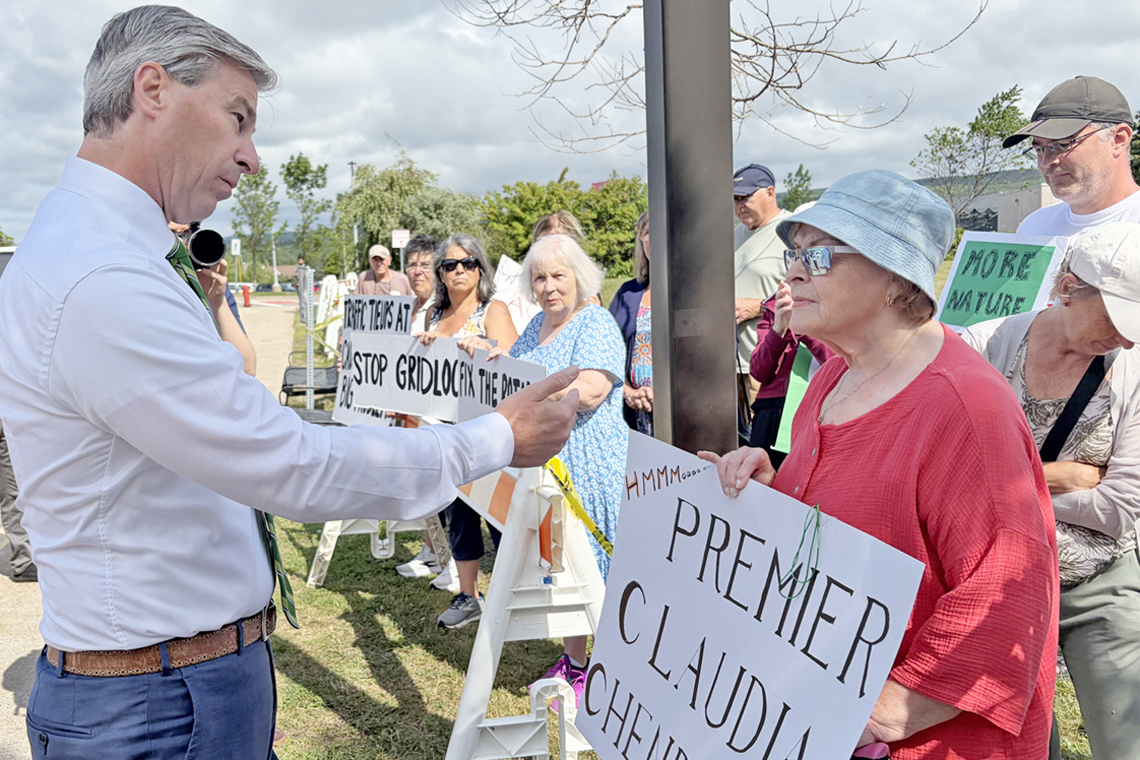
Premier Tim Houston spoke briefly to some of the protesters who gathered at the Port Hawkesbury Civic Centre to share their thoughts on a number of issues. He told Shirley Hartery with her “Premier Claudia Chender” sign that she’d regret that.
-by Beverley Phillips
In an address to the Strait Area Chamber of Commerce, Premier Tim Houston touted energy development and mining as the cure for the province’s economic woes.
At the $75-a-plate luncheon at the Port Hawkesbury Civic Centre, Houston used a medical analogy to describe the province’s state of affairs.
The diagnosis is that the province has a $1 billion deficit, possibly rising to $2 billion if labour issues need to be settled.
The treatment is more revenue. “There are a few ways you can do that,” said Houston. “Instead of raising your taxes, we are choosing to build our own economy and to build it safely.”
To do that, he championed natural gas, wind energy, and mining. “We are sitting on enough natural gas reserves,” Houston said, “to power our products, stabilize costs, and keep more Nova Scotia money in Nova Scotia for generations.”
He promises to do it responsibly. “Responsible governments insist on science,” said Houston. “Responsible governments protect the environment.”
In 2025, Houston lifted the hydraulic fracturing, or fracking, ban. His government tasked Dalhousie University with overseeing its $30 million Subsurface Energy Research and Development Investment program. Of that $30 million, over $24 million is earmarked for exploration incentives. Seven companies have expressed interest in the program.
Citizens and environmental groups have decried the move, citing concerns over water use and pollution, human health impacts, and the climate crisis. Climate research says climate change is here now, and economies need to rapidly decrease their reliance on fossil fuels to minimize how much global temperatures will rise. Natural gas is primarily methane, and methane is a very potent greenhouse gas. In the first 20 years of it being released into the atmosphere, it traps at least 80 times more heat than carbon dioxide.
Nova Scotia has legislated that greenhouse gas emissions be at least 53 per cent below 2005 levels by 2030 and net zero by 2050.
He then spoke about Wind West, a $60 billion project that could meet 27 per cent of Canada’s energy demands. It would be a massive integrated project of offshore wind farms and new transmission lines. “The entire world is looking at Nova Scotia,” he said. “The Prime Minister talks about Wind West all over the world in his meetings. For years, it felt like the wind was always in our face pushing us back. Now we have a chance to put it back at our backs, and we are using this opportunity to ensure that Nova Scotia will no longer be at the very end of the energy transmission line.”
With both on- and offshore natural gas and wind power, Houston said, “Nova Scotia has the opportunity to become one of Canada’s great energy provinces.”
He moved on to discussing mining for the material needed to build affordable housing, hospitals, and transmission lines. “We can import these materials from jurisdictions with weaker environmental records,” said Houston, “or we can mine those safely and responsibly here. I choose here.”
Earlier this year, Houston gave Australian mining company St Barbara permission to re-open their gold mine in Guysborough County. The company is also looking to expand operations under the name 15-Mile Mineral and Renewables with three new open pit mine sites. Indigenous groups and the St. Mary’s River Association have both expressed concerns about the environmental impact of these operations to local watersheds, which include important Atlantic salmon habitat.
In the fireside chat part of the afternoon, questions were collected and summarized from chamber members and posed to Houston. On population growth, he spoke of working with the federal government on immigration and on creating opportunities for people to move here or giving them reasons to stay here.
On how the Strait area fits into Nova Scotia’s economic future, and what opportunities have the greatest potential, Houston encouraged the audience to “think big” and said that the government “can come and add a little fuel to push their efforts forward.” He noted the military investments that the federal government is making would spill over out of Halifax to the rest of the province. But he said, “things around energy, around mining, these are tailor-made for rural areas and economic development in rural areas.” A planned media scrum was canceled, and the premier did not take questions from reporters