
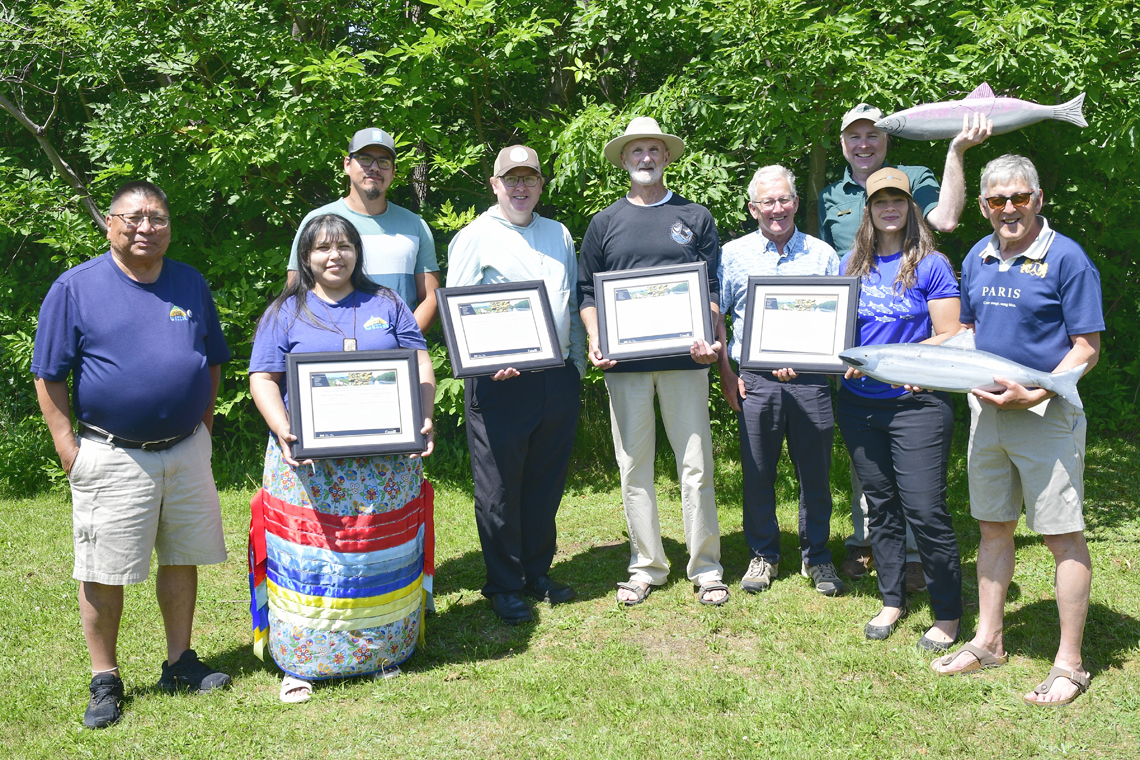
Local organizations received certificates for their role in Canada’s salmon river restoration work earning the designation of a UN World Restoration Flagship. On hand to celebrate the honour were: Keith Christmas (Unama’ki Institute of Natural Resources), Charlotte Denny (UINR), Jeremiah Johnson (UINR), Kris Hunter (Atlantic Salmon Federation), Bill Haley (Margaree Salmon Association), Rene Aucoin (Cheticamp River Salmon Association), Cal Martin (Parks Canada, in back), Jillian Baker (CRSA), Rejean Aucoin (Senator). (Photo supplied by Parks Canada)
-by Beverley Phillips
Canada’s hard work of restoring salmon river systems has been recognized by the United Nations as a World Restoration Flagship.
While it was announced last December, local organizations, including Parks Canada, Unama’ki Institute of Natural Resources, the Margaree Salmon Association, the Cheticamp River Salmon Association, and the Atlantic Salmon Federation, received their certificates of the honour on July 16th.
The goal of the designation is to prevent and reverse ecosystem degradation globally. A statement released by Parks Canada read, “UN World Restoration Flagship awards recognize initiatives that have advanced global food systems, biodiversity, and climate goals. Jointly led by the UN Environment Programme (UNEP) and the Food and Agriculture Organization of the United Nations, the awards are part of the UN Decade on Ecosystem Restoration (2021–2030).”
“The world restoration flagship represents some of the most ambitious, science-based, and inclusive examples of restoration in action. Projects that receive the honour are the best examples of large-scale and long-term ecosystem restoration in any country or region.”
The project honoured is called Respectful Returns. In announcing the award, the UN said, “Many salmon populations are in peril in Canada, with significant economic and cultural consequences – salmon hold profound spiritual value in Canada, particularly for Indigenous communities. Since 2010, Parks Canada has collaborated with Indigenous Peoples as well as local communities on the Respectful Returns initiative, which focuses on restoring damaged rivers and streams in seven national parks along Canada’s Pacific and Atlantic coasts.”
“The sites are Pacific Rim National Park Reserve, Gwaii Haanas National Park Reserve, National Marine Conservation Area Reserve, and Haida Heritage Site, Fundy National Park, Cape Breton Highlands National Park, Kouchibouguac National Park, Gros Morne National Park, and Terra Nova National Park.”
“By using new tools, sharing knowledge, and working together, the initiative has helped restore over 65,000 hectares (ha) of land and 228 kilometers of waterways with the goal of protecting salmon and their habitats, while strengthening connections between people and nature. Respectful Returns has also created more than 100 jobs with Parks Canada and with partners, helped reduce logging and illegal fishing, trained local and indigenous community members in research, project management, and monitoring in collaboration with three universities, and built strong partnerships with 32 organizations and communities. In six out of the seven sites, salmon numbers have already increased.”
Bill Haley, President of the Margaree Salmon Association, said, “This is awarded for something big, so it’s pretty special to receive this.”
He noted the various groups who will work together to earn the honour and said, “In this day and age, without volunteers and sound relationships with other groups, it’s hard to accomplish anything.”
Renée Aucoin of the Cheticamp River Salmon Association was also at the award ceremony and said, “It was an excellent opportunity to reconnect with the many people from Parks Canada and the organizations who are involved in river restoration in Cape Breton, Mainland NS and the Atlantic provinces.”
A statement by Parks Canada said, “This achievement would not have been possible without the dedication, integrity, expertise, and support of more than 30 partner organizations. Together, we have shown that Indigenous knowledge, science, and local communities can unite in trust and respect to restore salmon ecosystems. Our work is now a global model for biodiversity, climate resilience, and reconciliation, creating hope for future generations. This recognition inspires us to deepen collaboration, accelerate restoration, and nurture a healthier planet.”