
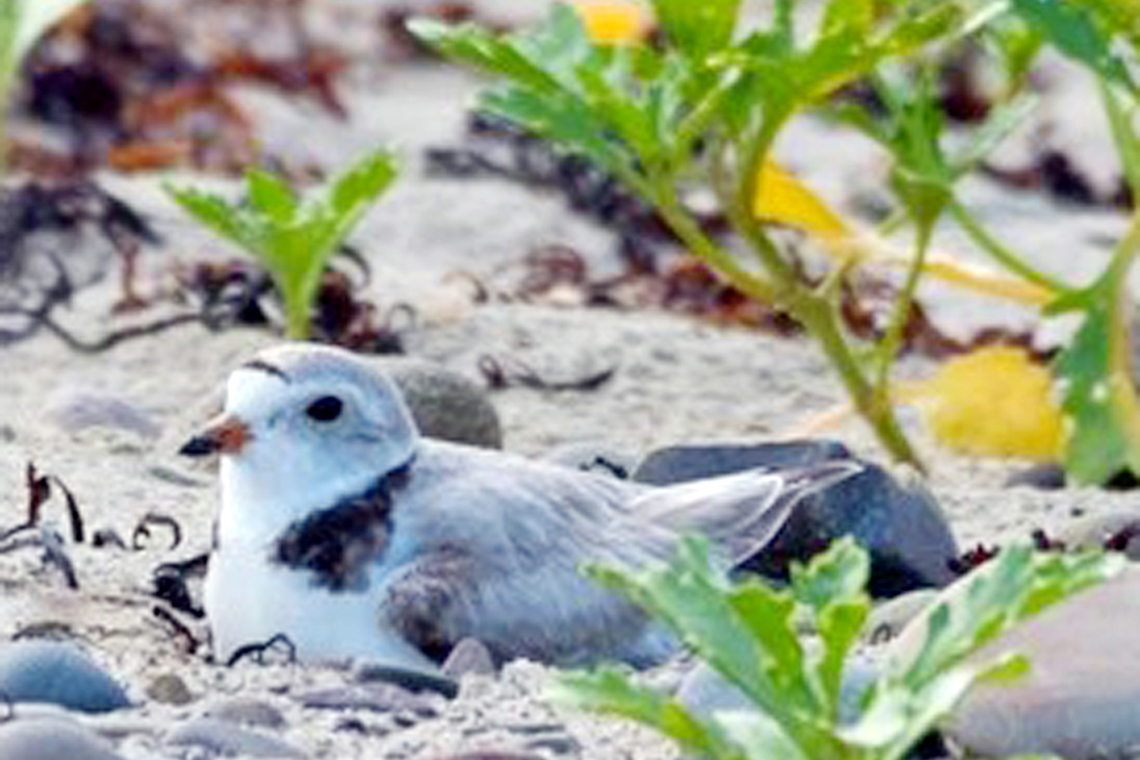
A piping plover nesting on Dominion Beach. Photo credit: Steve McGrath
-by Beverley Phillips
For the third year in a row, Nova Scotia has exceeded its conservation goal of 60 breeding pairs of piping plovers in the province, with 70 nesting pairs on 31 beaches. That is up from 62 pairs in 2024.
The endangered species also had great reproductive success (productivity rate) with an average of 2.03 fledglings (20-day-old chicks) per nest. The South Shore, in particular Shelburne County, had the most pairs and the most successful pairs.
Northern Nova Scotia was less productive. The region held steady with 17 pairs of birds for the third year in a row, but the birds had a productivity rate of 1.63, down from 2.33 in 2024. The provincial target is 1.65.
Sue Abbott, an associate director with Birds Canada, doesn’t know why that is. “We monitor a fair amount of things during our surveys,” she said, “but there are just some aspects we don’t know. They are wild birds, and they hold a lot of secrets. We just try our best and make beaches as safe as possible for them, but there are a lot of things out of our control.”
Inverness County, for the fifth year in a row, had no reports of nesting piping plovers. The last reported nesting was two pairs on Inverness Beach in 2020. Before that, there was consistently at least one pair on one of the county’s beaches, demonstrating that the beaches here can be good and productive nesting sites. Abbott said it is possible they simply didn’t see them when monitoring as some areas are hard to access.
There are a number of reasons that could explain the lack of local nesting. “We know the plovers need to have a space that feels safe for them to nest. So that means somewhere they’re not constantly getting disturbed by recreational activities or dogs off-leash. The other thing that they need is food. So if they’re arriving at a beach, and there’s not a good food supply for them, then they might move on. Predators, like foxes, harriers, or owls, in the area might spook them, causing them to move on. Not every site is going to be suitable for them, and that’s going to change over time. But then hopefully they do return in the future.”
Habitat loss and human disturbance are the main threats and cause of the decline in global piping plover numbers. While there are natural local factors at play, in general, a healthy piping plover population reflects healthy beaches, as they only live and nest on beaches. The ideal beach for a plover has lots of sand and cobble. In the winter, they are found in the Caribbean, the Bahamas, the southern US, and on beaches along the Gulf of Mexico. They fly north in the spring to breed, and birds have already been reported on Nova Scotia beaches.
The tiny shore birds will create a small depression, known as a scrape, above the waterline at the base of the dunes that they will line with small stones or shells. There they will lay four light-coloured speckled eggs that will take about a month to hatch.
As reported a couple of weeks ago, there was a recent court ruling that forced the federal government to change its approach to identifying critical habitat. It had begun using what is known as a bounding box approach. Environmental groups took the federal government to court over this, as they felt the wording was vague and confusing. The court agreed and ruled that the regulations must be clear and protect the entire beach.
When asked about the decision, Abbott recognized the win, but still had concerns as last year the province dumped cobble on Dominion Beach, a recognized piping plover nesting beach. “That’s an activity that likely destroyed critical habitat there,” said Abbott. “There’s so much more that we could do to improve protections, but we need the province to be doing that. We need better regulations that protect the whole habitat, not just the nesting sites.”
Becky Parker, executive director at Nature Nova Scotia, was involved in the court case. Parker sees the case as a win for piping plover populations, but agreed that concerns remain. “We consider it to be a win because we feel that critical habitat is, if it’s identified clearly, and the law is enforcible, then that’s a good thing for beach habitats,” she said. “However, critical habitat being identified is clearly not all that it takes to actually protect habitat on the ground. And we saw that at Dominion Beach, where the province seems to have just allowed for the destruction of critical habitat for a listed species at risk.”
Nature Nova Scotia is looking into the matter. “It’s our opinion that if the province could allow for the destruction of critical habitat, there must have been, either at the provincial or federal level, some kind of permit because both federal and provincial species-at-risk and other pieces of legislation are pretty clear that you can’t just harm species-at-risk habitat or wildlife habitat. There are loopholes in some legislation that more or less gives the minister in charge enough discretion over habitat that they can decide to destroy something if they decide that it’s for economic good. But there’s no evidence in this case, at least not visible to us yet, that there was any kind of decision made.”
Another concern they have is that the bounding box approach is still being used to define critical habitat for other species, and are keeping an eye on how it is used.
So while overall there is good news on the piping plover front, the work remains in monitoring and protecting them. “I think the most important thing this time of year is just reminding folks that we have plovers and other birds arriving on our shores,” said Abbott, “and they’ve just arrived after a long migration. Give birds some space, and some quiet time as well, to allow them to settle down and to establish a territory. As much as possible, walk on the wet sand and keep the pooch on a leash. If anyone has concerns, such as a lot of dogs off leash, ATVs on the beach, or signs of vehicle activity, they can call the Department of Natural Resources at 1800-565-2224 to report it so that they can know where there are problems and follow up as needed.”
Volunteers are also welcome to join them in their work in a number of ways. “They could help us check beaches to see if plovers are present. Once we identify that there are nesting pairs, volunteers can help us set up signs. Then, with some training, help us actually monitor nesting plovers from a safe distance. The other thing that volunteers can help with is doing outreach on the beach, talking to beachgoers and sharing plover-friendly messages, like walking on the wet sand where there are signs marking the nesting areas. We’ve had volunteers help us, even in schools, where we’ve done outreach activities, like getting kids engaged in painting local, special signs, just for that beach. It would be great to have more volunteers for Western Cape Breton.”
If interested in learning more about becoming a volunteer, reach out to Rielle Hoeg, Atlantic Outreach biologist, by emailing her at [email protected].