
-by Beverley Phillips
Last week, Tamara Deverell received an Oscar nomination for Best Production Design for her work on Guillermo del Toro’s Frankenstein.
She heard the news while sitting in the parking lot of Home Depot as she and her husband, Ken Woroner, were running errands in Sydney. “We were driving to Sydney because I had a dentist appointment there because we haven’t found a dentist closer yet,” said the Chimney Corner resident. “We realized it was 9:30 because my daughter had texted to say they make the announcements at 8:30 Eastern time. I turned my phone on and went to the live feed. As we were driving, we arrived at the Home Depot, and we sat in the car and listened to the announcements.”
“I can’t say I was surprised,” Deverell continued. “I figured that our film would be in there because they have five in each category.”
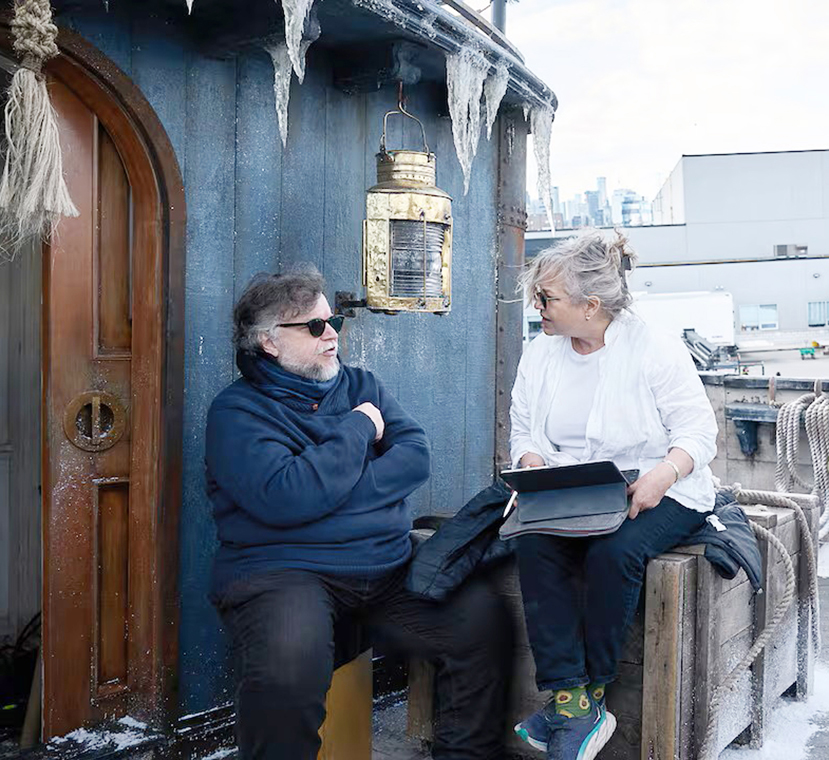
As a production designer, Deverell is responsible for everything seen on screen, and given the scope of the Netflix film, that was the biggest challenge. “I think we had about 200 sets and locations, and even more when we started,” she said. “And of those, there were maybe 30 sets that we built, either in the studio or on location. We had six studios full of sets. In a sound stage studio, you often have two or three sets, so all of the logistics of it. It was just like walking a tightrope of when to do things. And, also, the learning curve. I had to figure out how to do the lab, figure out the science of the time, the medical aspects of the time, and how to do the ship. Building a ship was a huge learning curve. It’s really like taking a crash course on all of those things.”
But the challenge is part of the fun of working on such a film, as is working with the people on her team. “I love my team. They are people that I’ve worked with through the years. There are a couple of new people, but they very quickly became part of this family. I just love working with these people, the painters, the carpenters, the welders, the greens people. It’s everything that I love to do, and when you get to do it with people, collaborate with them, it’s a great feeling.”
It’s not only her team that she has worked with before. She has often collaborated with del Toro. She received an Oscar nomination for her work on his Nightmare Alley, and she won an Emmy for her work on his Cabinet of Curiosities. On working with him, she said, “Well, he’s an artist himself. But we’re so very different. He’s Mexican, I’m Canadian, worlds apart, but we understand each other visually. I think it’s because we both come from artistic backgrounds, and our language is a visual language. I’m into art history; he, himself, is an art historian and certainly of cinema. He knows everything about cinema. He’s got a great slew of artistic reference points that he shares that I love to share. That’s a kind of artistic collaboration that you don’t get with a lot of people. And I’m more of a realist and a historian, and he’s more into the fantastical. We sort of meld those two things together, and I think, together, we give the audience something that’s believable and fantastic at the same time. That’s a nice energy that we have together.”
But her body of work includes much more than projects with such fantastical elements. She has also worked on productions such as Suits and Sophia Coppola’s Priscilla, which was based on Priscilla Presley’s autobiography from 1985. “Sophia Coppola has a very specific style, and in Priscilla, she’s telling the story from a female perspective. Sophia loves fashion, and decor, details like that. The opposite kind of director from Guillermo in so many ways. We were kind of creating a poetic memory of Priscilla’s life, so that was super fun to do. It was very evocative, and beautiful, and personal.”
And it was her work on Priscilla, in which Jacob Elordi played Elvis, that perhaps brought him into the conversation of who would play the creature in Frankenstein. Deverell was working on Frankenstein on her iPad in a back room while waiting to go on stage at the premiere of Priscilla. She tells Elordi what she is working on, to which he responds, “Oh, what I wouldn’t do to work on that.” And though they had Andrew Garfield already lined up for the role, “I’m glancing over at him thinking, because he’s so tall, he’d make a great creature,” she said.
As it turned out, Garfield had to back out of the role, and the next Monday morning, del Toro asked Deverell what she thought of Elordi for the role. “Normally, as a production designer, I’m not asked my impression of an actor by the director,” said Deverell, “but he knew I had just worked on a film with him. And he was the perfect person for the role.”
And to create the perfect set, Deverell doesn’t just sit at a computer but goes out to museums and locations to conduct research and find inspiration. The human touch, not AI, is necessary to create something that looks real on screen. “What I do on all movies is make things like the sets by hand to create real environments, aging, textures, and set dressing; everything’s perfect for the screen. And AI can’t give you that because AI has no human emotion or human storytelling ability. It’s a very good tool, but I would never use it to design a set. I’ve heard of designers doing that, where they literally typed in, “I want a post-apocalyptic staircase to nowhere, or a ruined castle of the 17th century in Scotland.” You can type that text in, and AI is going to take from different things that humans have created and create an AI version of it. So they all look the same, and it’s very boring. There’s no texture, no human tone or human history, no emotion or tonality. It’s a tool that we need to learn to use to our advantage to make things faster. Photoshop, for example, has AI aspects. It’s there for us to use, but it’s not there for us to abuse or create with.”
In all, Frankenstein received nine Academy Award nominations. They include: Best Picture, Best Supporting Actor – Jacob Elordi, Best Adapted Screenplay, Best Cinematography, Best Score, Best Costume Design, Best Makeup and Hairstyling, Best Production Design, and Best Sound.
The other movies nominated for Best Production Design include: Hamnet, Marty Supreme, One Battle After Another, and Sinners.
The Oscars will be presented on March 15th, and Inverness County movie fans can tune in to watch on CTV.