
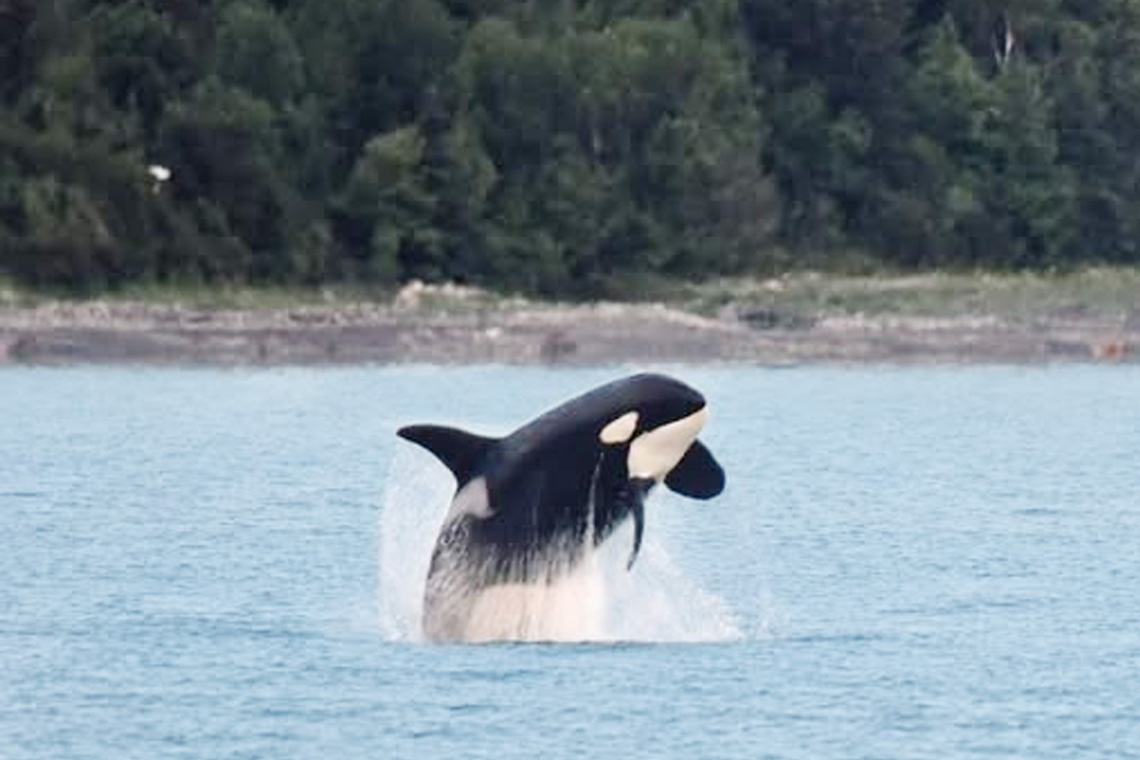
The orca at the causeway is causing quite a stir as people travel from near and far to catch a glimpse of him
-by Beverley Phillips
“There he is! There he is!” called out some excited children at a parking lot in Auld’s Cove on Sunday evening.
A steady stream of visitors stopped at the Canso Causeway over the weekend in hopes of catching a rare glimpse of an orca.
The orca was first captured on film late last week, and video clips and photos of the large marine mammal have been popping up on social media ever since.
Because orcas are rare in this part of the ocean, a number of people reported the animal to the Marine Animal Rescue Society (MARS). Tonya Wimmer, founder and co-executive director of MARS, said, “We aren’t doing any onsite work at the moment, just monitoring reports, as the animal is free-swimming and not seemingly in harm’s way.”
Orcas are found in all of the world’s oceans, from the Antarctic to the Arctic. Nova Scotia is within the range of the species, but they are rare to the waters off western Cape Breton.
While commonly called killer whales, orcas (Orcinus orca) are actually dolphins. The common name happens to come from ancient sailors who saw them attacking and eating whales. As the largest of the dolphin family, males can grow up to 10 metres long and weigh 10,000 kg. Females are smaller, growing up to 8.5 metres and 7,500 kgs. Orcas form matriarchal pods in which the oldest female passes on her knowledge to the younger generations.
The social nature of orcas is one reason the public showed concern for the lone animal at the causeway. Though the orca has shown no evidence of being sick, the idea was raised that this may be why he has been alone in the area. Wimmer said the dolphin is likely a male given the size of his dorsal fin.
While the whale part of their common name is misleading, the killer part is deadly accurate. They are an apex predator and feed on fish, squid, seals, seabirds, and as those ancient sailors observed, whales. They can travel up to 160 kilometres a day, so the visitor at the causeway must have found an adequate food source to keep him in the area for several days.
Over the weekend, boats were spotted approaching the animal. This led to concerned members of the public calling MARS again. Wimmer said, “We passed on the information to Fisheries and Oceans Canada, as it is their responsibility to enforce the Fisheries Act. We understand they were on site yesterday afternoon (Sunday) and are back on site this morning to keep an eye on the situation. Without a permit, people cannot approach these animals within 100 m.”
In a statement from DFO, they said:
“Fishery officers were on the water in the Auld’s Cove, Nova Scotia, north of the Canso Causeway on Sunday evening, July 26th, until roughly 9:30 p.m., and again on Monday, July 27th. The officers spoke with several vessel operators and reminded them that under the Marine Mammal Regulations vessels must maintain a minimum distance of 100 metres from whales, dolphins and porpoises, and at least 200 metres if the animals are with a calf.
‘While officers were on scene, no vessels were observed chasing or otherwise disturbing the orca.”
‘On Monday, July 27th, officers met with members of the Marine Animal Response Society to discuss the situation. Our officers flew a drone to gather footage of the whale, which may help assess its condition. Using the drone can also provide an opportunity to capture footage of any potential regulatory violations. A DFO vessel is in the area and ready to be deployed if needed.”
‘Officers are monitoring the situation and will patrol the area as needed. They will also continue to speak to vessel operators and observers on shore and inform them of regulations regarding approaching marine mammals.”
DFO regulations state that it’s against the law to disturb a marine mammal. Along with keeping at least 100 metres away, you cannot:
– feed, swim or interact with a marine mammal;
– move a marine mammal (or entice/cause it to move);
– separate a marine mammal from its group or go between it and a calf;
– trap a marine mammal or a group between a vessel and the shore, or between a vessel and other vessels;
– tag or mark a marine mammal.
Drones are discouraged for viewing marine mammals unless appropriate permits are obtained.
If you see anyone harassing any marine animal, you can call Crimestoppers at1-800-222-TIPS (8477), or 1-800-565-1633.