
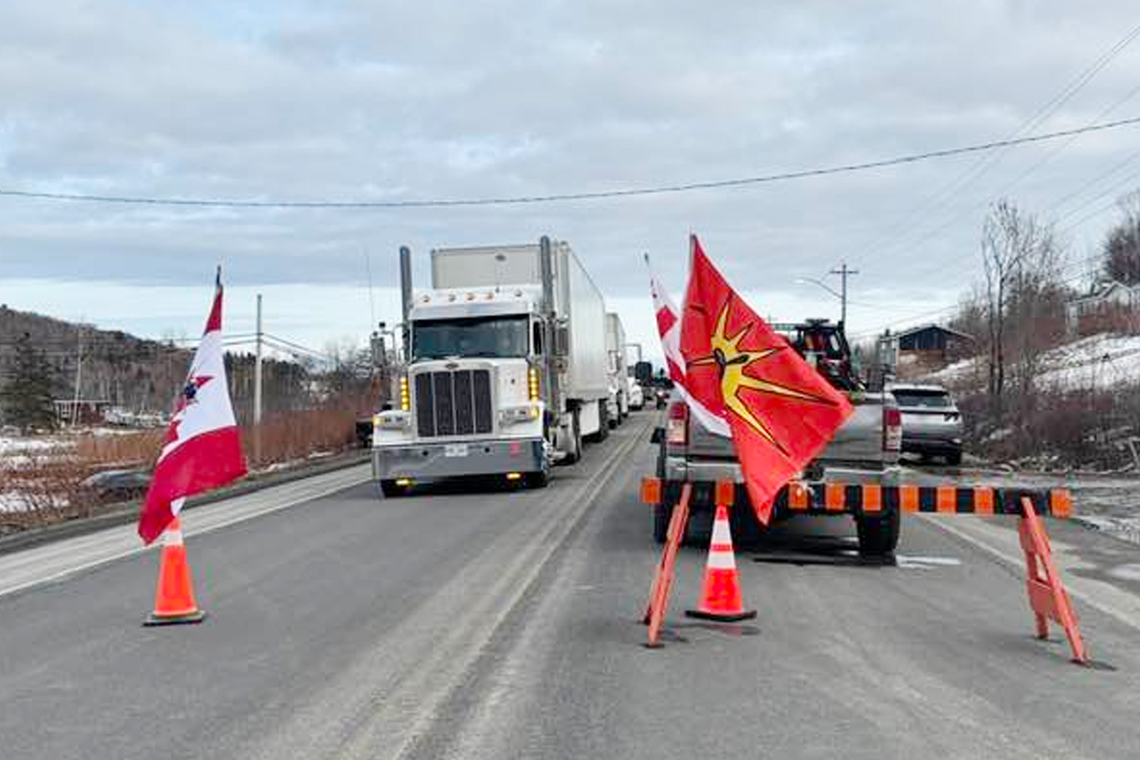
Organizers said that this was not a protest, what they were doing was disrupting the flow of goods just as the RCMP raids have disrupted their livelihoods. The community was backed by the chief and council when they decided to take a stand supporting other First Nations communities who have had their products seized.
-by April MacDonald
Tensions are running high between the Royal Canadian Mounted Police and Nova Scotia’s First Nations communities due to the ongoing raids and seizures of what the police call illegal cannabis and tobacco sales.
On April 2nd, in Potlotek First Nation, Northeast Nova RCMP seized illegal cannabis, arrested two people, responded to protests, and the investigations continue. RCMP officers executed a search warrant under the authority of the federal Cannabis Act at an illegal cannabis storefront on Hwy. 4 in Potlotek. They arrested two men on the premises and seized cannabis products.
After the RCMP raided the shop, a community group gathered in protest, blocked Hwy. 4, and surrounded the police vehicles, demanding the return of the products that had been confiscated.
Officers were forced to leave their vehicles.
RCMP cleared their vehicles of all weapons and their Mobile Data Terminals or Mobile Data Computers. These devices are used by RCMP and local police services (such as Halifax Regional Police) to access computer-aided dispatch systems, check vehicle and personal records, run license plates, and write reports. The computers are part of a broader “mobile office” system aimed at keeping officers on the road.
Officers departed on foot, while their vehicles remained in Potlotek; unmarked police vehicles picked up the officers and escorted them out of the area.
RCMP state that Hwy. 4 was illegally blocked by heavy equipment as well as a large group of protesters throughout the day.
Richmond County District RCMP and the Nova Scotia RCMP Division Liaison Team engaged in communications with community leaders in an attempt to resolve the situation peacefully.
Once word spread throughout First Nations communities, community meetings took place, namely in We’koqma’q First Nation. Later that afternoon, the Oran received a call from a local councillor stating that protesters were obstructing Hwy. 105 in Whycocomagh/We’koqma’q.
There were transport trucks lined up as far as the eye could see from the roundabout and up Hwy. 104 towards Port Hastings.
Organizers were safely directing vehicular traffic in and out of the area, stating they were not protesters but that they were disrupters.
Councillor Katerina Basque was on the scene directing traffic; she said once the community heard about the situation in Potlotek they got together to stand with their brothers and sisters in what they call illegal raids and RCMP once again terrorizing their community.
Many said that these raids were traumatizing and triggering especially for elders in the community who lived through or were survivors of Residential schools. Those that we spoke to who were leading the blockade said RCMP continue to strip away their autonomy and right to provide for their families and community.
Madonna Bernard said that once again the Mi’kmaq are under strict control of the government and the RCMP.
“Our people have had enough trauma, loss of identity, loss of traditions, and ongoing economic challenges. Now that we are making a living through our legal right to sell cannabis, they raid us, they steal from us,” said Bernard.
“They are disrupting us; we can be disrupters too,” she added.
The Mi’kmaq rights to sell cannabis in Nova Scotia are currently the subject of an intense legal and political battle, with Mi’kmaw leaders asserting inherent and treaty rights to manage their own economies while the province maintains that all cannabis sales must adhere to the Nova Scotia Liquor Corporation regulations.
“We are doing this for our kids, for your kids, for the future,” she added.
Bernard said that they were going to open the blockade by 7:00 p.m.
Back in Potlotek, seven RCMP vehicles that were abandoned were removed from the community.
There was significant damage to the vehicles, including broken windows, dents, deflated tires, removed tires, and urine-soaked interior surfaces.
Many Mi’kmaw chiefs and operators argue that the 1752 Peace and Friendship Treaty, which allows for the sale of goods at “truckhouses,” justifies the sale of cannabis. They view the sale of cannabis as part of their sovereign right to economic development and a “moderate livelihood.”
The Nova Scotia government maintains that only the NSLC is authorized to sell cannabis in the province. The province argues that unlicensed stores are illegal, unregulated, and pose a health and safety risk to consumers and youth.
The RCMP say they will continue to conduct raids on unlicensed cannabis shops on First Nations reserves, including in Membertou, Potlotek, Eskasoni, and We’koqma’q.