
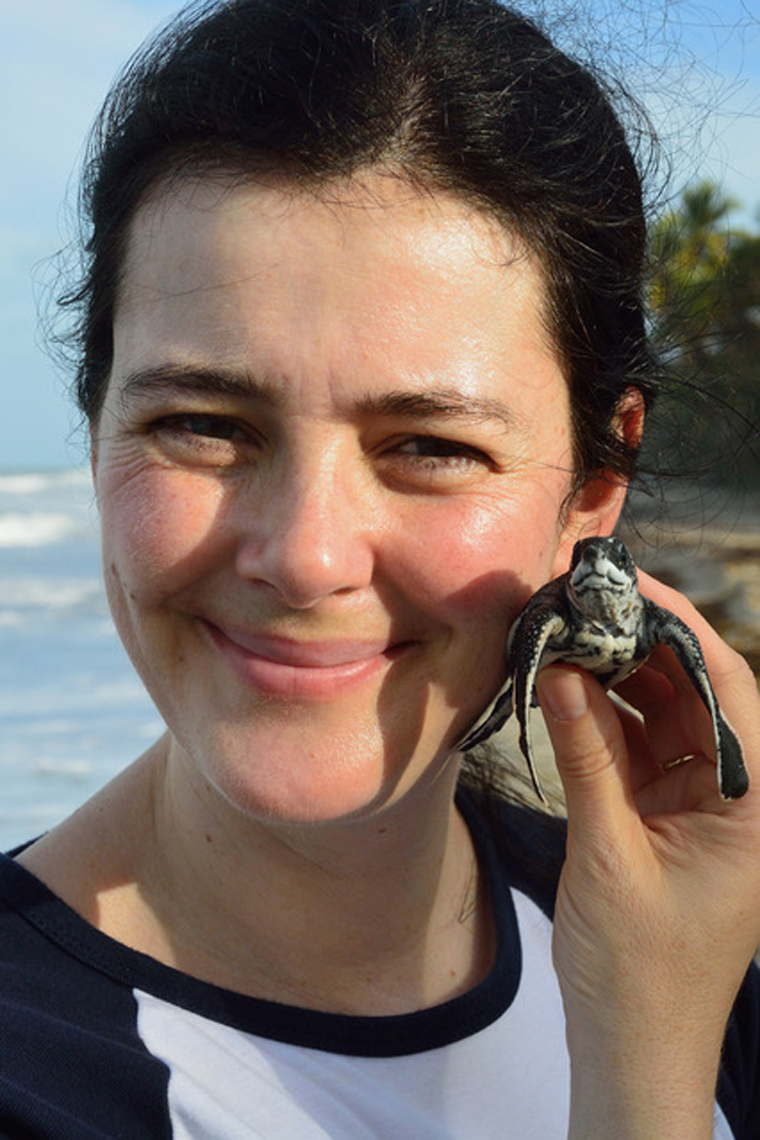
Kathleen Martin is passionate about conserving leatherback sea turtles and encourages others to join her in the mission
-by Beverley Phillips
Note: This is the fifth and final instalment of the series on Dina, the leatherback sea turtle who died having tried to navigate around the Canso Causeway nine times in the fall of 2024.
Dina was not the first leatherback sea turtle to die because she couldn’t get through the Canso Causeway, and she won’t be the last.
It has only been since 1998 that leatherback sea turtles have even been on the Canadian radar. That was the when the Canadian Sea Turtle Network (CSTN) began operations and started asking people, “Have you seen this turtle?” Kathleen Martin, executive director of the CSTN, said that once people started looking for them, they started hearing about them. Before that, it was simply not something that was noted. There have been no specific studies on how many leatherbacks die in our waters because of the Canso Causeway. It would be a very difficult statistic to measure as not all wash up on shore nearby. Dina’s never did. She died at sea, and her body was not recovered.
But Hoodie’s was. Hoodie was a leatherback sea turtle found by Mary Janet MacDonald on Port Hood Beach on November 30th, 2024, just as a saga of Dina was playing out, just weeks before she died.
Martin was part of his recovery mission. Initially, they hoped he would survive, but he didn’t. “He was just emaciated,” she said. “When leatherbacks are in Nova Scotian or Atlantic Canadian waters, they are 33 per cent heavier than when they are on a nesting beach. They come here to get fat on jellyfish. Three of us picked that animal up. Usually you can’t move a leatherback turtle because they weigh 1000 pounds.”
Martin remained with Hoodie for the necropsy with Dr. Laura Bourque, a pathologist at the Atlantic Veterinary College (AVC) in Prince Edward Island. “It was so hard to see,” said Martin. “There were marks going down the side of his carapace, and Bourque said, ‘Oh God, it’s chafing.’”
“When leatherbacks get cold, they swim faster,” continued Martin, “because they’re trying to warm up. The animal was swimming so fast he chafed down the side of his carapace. If you could spend just two minutes, imagining the panic and the strain in that animal. How stressed he would be because he’s supposed to be going south and what it would feel like when the water temperature drops and you’re in there, and you can’t get out of it, and you’re frantic about it. It’s a horrific way to die. It’s not like they just pleasantly get colder. He was fighting for his life.”
An email from veterinarian Dr. Lara Cusak of the AVC turned up in the Access to Information and Privacy (ATIP) document that revealed how the Department of Fisheries and Oceans was responding to the news of Dina being stuck in the Gulf of St. Lawrence. On December 18th, Cusack wrote to Mike James, an aquatic science biologist, stating her animal welfare concerns for Dina. “It is obvious to me that her prolonged stay in our waters poses significant welfare concerns, such as loss of body condition, hypothermia, and ultimately death. This animal will undoubtedly suffer and experience prolonged deterioration prior to her death. I think the ability to prevent animal suffering makes it very much worth the effort to try and save this animal.”
At this point, the rescue mission had already been called off by the Executive Director of MAR, and this message set off a flurry of emails and rationale to mount a response.
But no response was coming, and media lines were being drafted by DFO communications specialists. DFO was only willing to give so much information, but had responses ready for questions “If pressed on…” by the media. For example, “If pressed on responding to sea turtles in distress: Response efforts may take place for sea turtles that are injured, stranded, or entangled. The tagged leatherback turtle is not injured, stranded, or entangled.”
As reported last week, advocates for action want to see a safe passage for wildlife created at the Canso Causeway, likely in the form of a bridge, replacing part of it. This would bring the causeway in compliance with the Fisheries Act. If this were to happen, some may be concerned about what it would mean for the ice-free harbour status of the south side of the Causeway.
Mike Dadswell, Acadia University biology professor and former DFO scientist, said the space needed for wildlife to get through wouldn’t need to be that big, and that little ice would get through.
Bruce Hatcher, Chair of Marine Ecosystem Research at CBU, added it was likely the increase in water circulation would actually decrease the amount of ice on the north side because the water would be moving more. And as the south side would become more energetic, any ice that did come through would be moved out quickly.
In his opinion, climate change is the bigger unknown, as it has rapidly been changing ocean conditions and its movements.
This is why Hatcher wants to see more science done in the area. Though not related to this issue, he has a post-doctoral student beginning this summer who will be looking at some of the physical, chemical, and biological water properties from the Northumberland Strait, through the Strait of Canso, down to the Chedabucto Bay, measuring such things as salinity, temperature and alkalinity.
He also thought, should a bridge be in the Causeway’s future, that it would be a good idea to look to capture the energy of the water movements and turn it into electricity. This would also help manage the current, slowing the passage of water through the gap. “Of course,” he added, “it would have to be designed to not kill any organisms.”
He saw this as a real opportunity for Port Hawkesbury. “I think it is a time of a great deal of capacity building in the Strait area,” he said. “We’ve got the nautical institute there, the NSCC, all kinds of people with engineering smarts and so on. If there’s any place that this alteration to the structure and function of the causeway could be done, to both improve the ecological function of that part of the ocean, while at the same time providing renewable energy to the people that live there. I think that’s certainly worth thinking about.”
The cost of replacing a piece of the Causeway with a bridge would be formidable, but Darren Porter, the fisherman who got the ATIP, has an idea about that. “This is the mother of all offsets,” he said.
Offset projects are required for projects and industries that harm the environment. They need to offset that damage by doing something helpful somewhere else.
“The gold mines are coming. Even if we don’t want them, they’re coming,” he said. “They’re going to need massive offsets. This is an opportunity.”
The notes on this in the ATIP were scant, but fisheries biologist Colleen Smith said, “This was the offset project of the century. Mike Womble agrees – offset project and so much money, no proponent would be able to pay for it.”
Martin acknowledges the challenges in solving the problem of the causeway to sea turtles. But in her mind, just because it’s hard doesn’t mean we shouldn’t try. The emotion in her voice was palpable as she spoke. “It doesn’t make sense, and it just needs to change,” she said, “and I think it’s something that we can change. It’s really upsetting information. But it means that citizens and politicians today can get to be the people that make a change that makes a difference. People are always looking for meaning in life, especially now. We’re desperate for stories where we matter. There’s this world that seems so out of control in so many ways, and we could do this thing that would be a good thing and a big thing and something where communities and governments and everyone comes together to do something. That’s what is life-giving for people, right?
“I work with a lot of young people. It’s a hard world out there right now. And when you think about the capacity of the Nova Scotia and federal governments to come in and say, ‘You know what we’re going to do right now? We’re going to show you that there is light in this world, and that when something’s wrong, we fix it. When we know better, we do better.’”
“The Canso Causeway is a perfect example of that. What an amazing thing to do for wildlife. These are federally protected species, so there’s a mandate to do it. But beyond that, I also think it’s ethical and moral.”
“So often as adults, we keep saying, “Aren’t you excited about the youth of today and that they’re going to change the world and lead the world?” I think that’s a cop out. And it’s a terrible thing to put the weight of the world on a child. It’s irresponsible of adults to say, “Hey, the future is yours, and we can’t wait to see you fix our mess.” We’ve left them with the mess, and they’re going to clean it up. Oh my goodness, we need to clean up our own mess. We are the people the world has been waiting for – this generation, these adults, these seniors. And as adults, it’s our job to take care of what’s going on here. It’s not up to them. We’re constantly passing the buck. We’re shirking our responsibility and pretending that they can do it instead of us, and isn’t that sweet?”
“The strain on kids is real. I see it in kids when I’m talking to them in groups and classrooms. Kids who are six years old are saying, ‘What can I do? I want to fix it. How can I help?’ And they make these really beautiful letters and pictures and signs and put their whole hearts into it. And actually, what they need to know is that there are adults in the room who will take care of them and who are willing to do the work right now. We’ve forgotten how, at one point in our lives, everyone looked at us and thought, ‘Aren’t they going to do all the amazing things?’ And now that we get to be the adults, we’re saying, “Oh, that wasn’t us. It’s the next generation.” Actually no, it’s us right here. We’re supposed to be the people that the world needs. We’re the people meant to meet this moment. And that’s incredible. This is an amazing thing that we have as an opportunity, as a community, as a province, and as adults to say, ‘Hey, this is wrong. We’re going to fix it.’”
“Let’s do this thing. Let’s remember our potential and act on it. That’s the line that you want in your obituary, right? That you helped conserve a critically endangered species. You want to be on the team that helped the turtle, not on the team that said, ‘I don’t really know if we want to make sure that that causeway changes.’ You want to be on team, ‘I did everything I could do.’ The beauty of it is in making the change; the beauty of it is the hard work. And it’s the coming together, and it’s the hard conversations. That’s where life exists, and love exists, and we remind ourselves of the potential that we all have. It’s that space where we live up to being the people we’re meant to be.”
It was planned that Martin would have the last word in this story. But as writing was wrapping up on Monday, Brittany Wentzell on Information Morning Sydney was speaking to Fred Tilley, the provincial Minister for Public Works. While he was on for another issue, she asked him about the causeway at the end of the interview. He said, “We are operating based on the current regulations. At some point there will probably be a replacement required of equipment. At that time, we would look at whatever the regulations are and make sure we follow those, but we wouldn’t be doing anything specific right now for migration.”
He said the province would be open to talking about it if the federal government was moving forward with change and were funding it. But, he concluded, “There are alternate routes for turtles and other sea life around that area. I don’t see us doing anything to change the Causeway at this point.”
The Canso Causeway itself is provincial jurisdiction. Minister Tilley can be contacted by emailing him at [email protected] or calling 902-736-0546. The address for his constituency office is: 2 Elliott Street Sydney Mines, NS B1V 3G1.
Other contacts:
– MLA Kyle MacQuarrie: [email protected], 902-258-2216;
– MLA Claude Bourgeois: [email protected], 902-705-5727;
– The Canso Canal, the Fisheries Act, and the Species at Risk Act are federal jurisdiction. To contact MP Jaime Battiste: [email protected], 1-866-707-9800, Main constituency office: 729 Highway 105 Boularderie East, Nova Scotia B1X 0A2;
– Minister of Fisheries and Oceans: The Honourable Joanne Thompson, minister’s office: 200 Kent St, Station 15N100, Ottawa ON K1A 0E6, email: [email protected].